
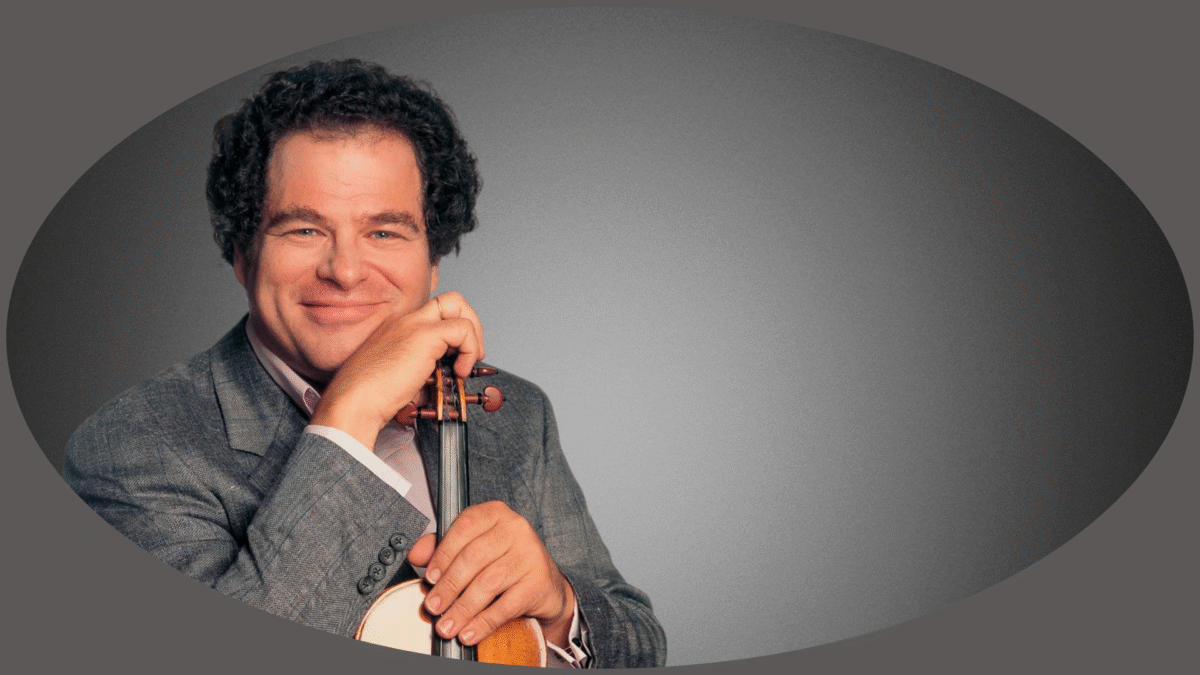

Itzhak Perlman was born in Tel Aviv in 1945, at a time when the region was still under the British Mandate of Palestine. His early life was shaped by both cultural richness and personal hardship. At the age of four, he contracted polio, a disease that permanently affected his legs and required him to use crutches or a motorized scooter throughout his life. This physical challenge, however, never limited his musical imagination or determination.
From a very young age, Perlman showed an extraordinary fascination with sound. His exposure to music began through the radio, where he first encountered classical violin performances. Unlike many prodigies who begin formal training early, Perlman’s first steps into structured musical education came after his illness stabilized. He initially studied in Israel, attending the Shulamit Conservatory and later the Academy of Music in Tel Aviv. These early years laid the foundation for a discipline that would define his entire career.
Even in his youth, his playing carried a distinctive emotional depth. Teachers and peers often noted that he did not merely play notes but shaped phrases with instinctive musical storytelling. This early development of expression over technical display would later become one of his defining artistic signatures.
Journey to International Recognition
Perlman’s rise to global prominence began when he moved to the United States in the early 1960s. He was accepted into the prestigious Juilliard School in New York City, where he studied under the legendary violin pedagogue Ivan Galamian and later with Dorothy DeLay. These mentors played a crucial role in refining his already remarkable abilities, particularly in tone control, bow technique, and interpretative clarity.
His breakthrough came in 1964 when he won the prestigious Leventritt Competition. This victory immediately placed him among the most promising violinists of his generation and led to his debut with major orchestras across the United States. Critics quickly noticed that Perlman was different from many virtuosos of the time. His performances were not built on speed or technical exhibition alone but on a deeply human musical voice that seemed to communicate directly with audiences.
By the late 1960s, he was performing with leading orchestras such as the New York Philharmonic, the Chicago Symphony Orchestra, and the Philadelphia Orchestra. His reputation expanded rapidly, and within a few years, he became one of the most sought-after violinists in the world.
Artistic Style and Musical Identity
Perlman’s playing style is often described as warm, rich, and deeply expressive. Unlike violinists who emphasize technical brilliance or intellectual interpretation, his approach centers on emotional communication. His tone is famously full-bodied and singing, often compared to the human voice in its natural phrasing and emotional range.
One of the most distinctive features of his artistry is his ability to balance precision with spontaneity. Even in highly structured works by composers such as Beethoven, Brahms, or Tchaikovsky, Perlman introduces subtle variations in phrasing that make each performance feel alive and unique. This quality has made his recordings enduring reference points for students and professionals alike.
His physical condition also influenced his musical presence. Because he performs seated, Perlman developed a unique posture and bowing technique that many observers believe contributes to his sound production. Rather than limiting him, his adaptation became part of his identity as an artist who redefined what is physically possible in classical performance.
Major Performances and Global Career
Throughout his career, Perlman has performed on nearly every major concert stage in the world. From Carnegie Hall in New York to the Royal Albert Hall in London, his appearances have consistently drawn critical acclaim and enthusiastic audiences.
He has collaborated with many of the greatest conductors of the modern era, including Zubin Mehta, Daniel Barenboim, and James Levine. These partnerships produced some of the most celebrated interpretations of violin repertoire in the late 20th century.
Perlman’s repertoire is unusually broad. While he is best known for his interpretations of Romantic-era composers, he has also performed Baroque works by Bach and contemporary compositions written specifically for him. His willingness to engage with modern music has helped bridge the gap between traditional classical audiences and newer experimental forms.
In addition to orchestral performances, Perlman is also a celebrated chamber musician. His collaborations with artists such as Vladimir Ashkenazy and Yo-Yo Ma have resulted in recordings that are widely regarded as benchmarks in chamber music interpretation.
Recordings and Musical Legacy
Perlman’s discography is extensive and influential. He has recorded major violin concertos by Beethoven, Brahms, Mendelssohn, Sibelius, Tchaikovsky, and Mozart, among others. These recordings are often used as educational references in conservatories and music schools around the world.
One of his most celebrated recordings is the Brahms Violin Concerto with the Boston Symphony Orchestra, conducted by Seiji Ozawa. This performance is frequently praised for its emotional depth and structural clarity. Another landmark recording is his interpretation of the Beethoven Violin Concerto, which showcases his ability to blend lyrical warmth with architectural precision.
Beyond classical repertoire, Perlman has also explored film music and popular collaborations. His participation in the soundtrack of Schindler’s List brought his artistry to a wider global audience. The haunting violin themes became symbolic of emotional storytelling through music, demonstrating his ability to transcend genre boundaries.
Teaching and Influence on Future Generations
In addition to performing, Perlman has had a significant impact as an শিক্ষক and mentor. He has taught at institutions such as The Juilliard School, where he has influenced countless young violinists. His teaching philosophy emphasizes musicality over mechanical perfection, encouraging students to find their own interpretative voice.
Many of his students have gone on to become successful performers and educators themselves, spreading his artistic values across generations. His masterclasses are particularly admired for their clarity and warmth. Rather than focusing solely on technical correction, he often encourages students to think about emotional storytelling, phrasing, and character within music.
Perlman’s influence extends beyond formal teaching. Through televised performances, interviews, and documentaries, he has helped demystify classical music for broader audiences. His approachable personality and humor have made him one of the most beloved figures in the classical music world.
Challenges, Resilience, and Public Image
Perlman’s life story is also a powerful example of resilience. Living with polio from childhood, he has never allowed physical limitations to define his identity or career. Instead, he has consistently emphasized adaptability and perseverance.
On stage, he performs with visible ease and confidence, often engaging with audiences in a warm and informal manner. His presence challenges traditional assumptions about disability in classical music performance, demonstrating that artistic excellence is not confined by physical ability.
Despite international fame, Perlman has maintained a grounded public image. He is known for his humor, humility, and generosity toward younger musicians. These personal qualities have contributed significantly to his lasting popularity beyond the concert hall.
Awards, Honors, and Recognition
Over the decades, Perlman has received numerous awards recognizing both his artistic excellence and cultural impact. These include multiple Grammy Awards, the National Medal of Arts in the United States, and the Presidential Medal of Freedom, one of the highest civilian honors in the country.
He has also been honored by institutions around the world for his contributions to music and education. Universities and conservatories frequently award him honorary doctorates in recognition of his global influence on classical music performance and pedagogy.
These honors reflect not only his technical mastery but also his role as a cultural ambassador for classical music in the modern era.
Cultural Impact and Lasting Legacy
The legacy of Itzhak Perlman extends far beyond the concert stage. He represents a bridge between tradition and accessibility in classical music. At a time when the genre is often perceived as distant or elite, Perlman has helped bring it closer to everyday audiences.
His performances in films, television specials, and public concerts have introduced millions of people to classical violin music who might otherwise never have engaged with it. He has also played a significant role in preserving and promoting Jewish musical heritage through both performance and education.
Perhaps most importantly, Perlman’s life story continues to inspire not only musicians but anyone facing personal challenges. His journey demonstrates that artistic greatness is not defined by physical perfection but by emotional depth, discipline, and authenticity.
Conclusion: A Living Symbol of Musical Humanity
Itzhak Perlman remains one of the most influential violinists in modern history. His contributions to performance, education, and cultural outreach have shaped the landscape of classical music for more than half a century.
What distinguishes him is not only technical brilliance but a profound sense of humanity in his music. Every note he plays carries a sense of storytelling, memory, and emotional truth. His legacy is not confined to recordings or awards but lives on in the countless musicians he has inspired and the audiences he has moved.
In the history of classical music, few artists have achieved such a balance of mastery, accessibility, and emotional resonance. Perlman stands as a reminder that music, at its highest level, is not just an art form but a deeply human expression of life itself.